
If your company handles registrant data in any way, you need robust practices in place to ensure sensitive and personal information is protected. From automated reporting to integrated payment processing, numerous features of online registration software help secure your registrants' data.
This guide from Regpack explores how you can ensure data security with online registration software, covering what makes data security important, ways to leverage registration software for ultimate data protection, and more.
- Why Is Data Security Important for Registration?
- How Can You Ensure Data Security With Online Registration Platforms?
- Additional Benefits of Online Registration Software
- Leverage Online Registration Platforms to Protect Sensitive Data
Why Is Data Security Important for Registration?
For any company that receives, stores, or utilizes customer data, it is imperative that data security protocols are in place. Data breaches can pose a range of common security threats to registration systems, impacting both your company and registrants, including financial losses, severe reputational damage, and a loss of consumer trust.
Here's why ensuring data security is paramount.
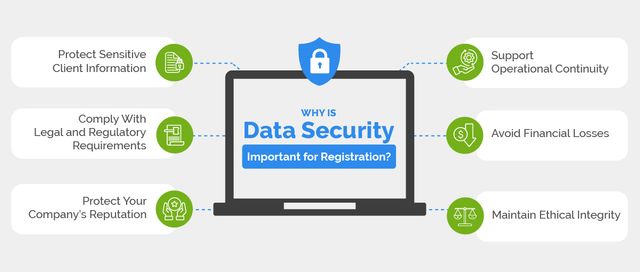
Protect Sensitive Client Information
Data security protocols aim to protect the sensitive information of your registrants and customers, including personally identifiable information (PII), financial data, biometric data, business-sensitive data, and personal attributes information.
Online registration software should integrate security measures that can help you protect sensitive information and:
- Prevent identity theft: Many registration forms require personal and personally identifiable information, which, when accessible to cybercriminals, can be used to commit identity theft. Identity theft can cause significant financial and emotional issues for your registrants.
- Reduce the risk of financial fraud: When registrants share their card details and financial information through your online forms, their data must be comprehensively protected to avoid unauthorized transactions.
- Limit emotional distress: When inadequately protected, clients' sensitive information can be used in ways that cause stress and impact their emotional well-being.
- Build trust: If your organization can effectively protect client information, you are more likely to build trust with your consumers and foster lasting relationships.
Comply With Legal and Regulatory Requirements
If your company deals with personal or sensitive data in any way, you will need to comply with the relevant legal and regulatory requirements, many of which pertain to data security.
Most online registration software is built to help you adhere to compulsory requirements, which can help your company:
- Avoid penalties: You must comply with state and federal regulations that mandate how personal data should be collected, stored, and communicated. For example, businesses that handle health care-related data must comply with federal HIPAA regulations. Failure to comply with data security and management regulations can result in substantial fines and public reprimands.
- Clarify requirements for users: Most online registration software enables you to choose how to make compliance regulations clear for consumers. For example, most software offers features such as consent pop-ups, privacy policy integration, and explicit opt-ins.
Although online registration providers can assist you in your business's compliance management, it is ultimately your responsibility. To ensure you fully understand and fulfill your obligations, you must assess your local, global, federal, and industry-specific regulations. For example, California alone has more than 25 state privacy and data security laws that its businesses must adhere to.
Protect Your Company's Reputation
Failure to provide adequate data protection can result in breaches, which can damage your reputation and business success. Data breaches can lead to:
- Negative publicity: In the data protection sphere, news of data breaches can spread fast and furiously, and your business can quickly be deemed untrustworthy.
- Stifled growth: If past or current registrants have a negative experience and cannot trust you to protect your data, future ones won't either.
- Competitive disadvantage: Data breaches put your company at a major competitive disadvantage. Being able to protect your clients' data is considered the bare minimum for companies that handle sensitive information, and an inability to do so makes you far less appealing than your competitors.
Support Operational Continuity
Dealing with data breaches and their subsequent fallout can disrupt your operations. Having robustly secured data can:
- Reduce disruptions: Data breaches can halt operations. As you react to a breach, investigate its cause and work to resolve subsequent issues, your operations may be severely disrupted.
- Divert resources: The more time and resources you spend on dealing with a breach, the more valuable resources you are diverting that could otherwise be dedicated to advancing operations, enhancing your products and services, and more.
Avoid Financial Losses
Issues with data security can cause a host of financial difficulties. Data breaches can lead to financial losses through:
- Loss of customers: If your business experiences a data breach, you are likely to lose customers and see a decline in business.
- Invested resources: You will need to dedicate resources to investigating and resolving the breach and rectifying any issues it has caused.
- Litigation fees: If your data breach is due to negligence or noncompliance, you could be liable and may need to resolve issues legally. Any legal processes will incur attorney and court fees, and could even lead to client settlements.
Maintain Ethical Integrity
Beyond the success or finances of your business, you have a moral obligation to protect your clients' right to privacy, and to ensure the complete safety of their personal information. Ensuring data security helps you uphold your moral duties as a business and maintain ethical integrity.
See your numbers
Get a personalized, no-commitment savings report.
Have a question?
Ask Regpack AI anything.
How Can You Ensure Data Security With Online Registration Platforms?
Online registration platforms provide the tools and features you need to ensure data security throughout the registration journey. Discover what makes online registration software secure, and how different registration software features ensure data security.
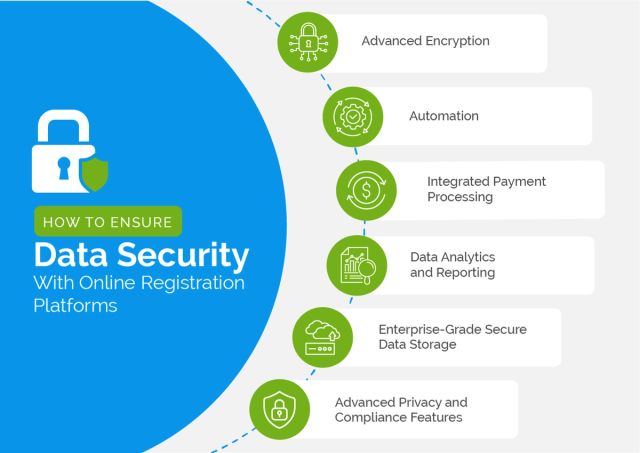
Advanced Encryption
When you choose an online registration platform that meets the global benchmark of advanced encryption protocols, user data should be stored securely both in transit and at rest. Most platforms align with the Advanced Encryption Standard (AES), which protects data as it is transferred and stored online. Encrypting data makes it unreadable should it be compromised, protecting it from being stolen or changed.
Encryption in transit protects your data as it actively moves from one place to another online, while encryption at rest protects data as it is being stored in databases. Encryption is a key component of data security as it minimizes cybercriminals' ability to decipher it, so even if unauthorized access occurs, the data is unusable.
To comply with the AES, all data exchanged between the user's browser and the registration software's servers must be encrypted using Secure Sockets Layer (SSL) or Transport Layer Security (TLS).
Automation
Online registration software automates many steps involved in the registration process, including:
- Payment processing
- Form creation
- Communication and notifications
- Reporting and analytics
- Encryption
- Compliance checks
Automation can drastically improve data security by:
- Minimizing human error: When data is processed manually, there are more opportunities for mistakes. Manual data processing can lead to accidental exposure, input errors, incorrect data placement, and more. When the registration process is automated, data is automatically transferred from the registration form to online storage databases without error.
- Enforcing continuous security measures: Automated security protocols include encryption, regular backups, real-time threat monitoring, and streamlined compliance efforts.
Integrated Payment Processing
One of the primary benefits of online registration software is its integrated payment processing.
With integrated payment processes, you can avoid the risks associated with manual payments, such as cash exchange, paper checks, and offline exchanges of financial information. For a safe method of taking bank and payment details, choose an online registration platform that integrates online payments.
Look for a platform that supports multiple currencies and a range of payment types, such as credit cards, debit cards, and digital wallets.
Data Analytics and Reporting
Most online registration software is data-driven and benefits from integrated reporting dashboards, which can help you understand your company's data storage and use.
Access to real-time data can provide important insights to make data-driven safety decisions and identify any potential risks early on. Having an overview of all your company's data helps you see the bigger picture, and such advanced features are not available with in-person or manual registration processes.
Look for the following features when choosing an online registration platform:
- The ability to filter by event, region, audience type, industry, and any other custom fields you need
- Real-time dashboards with useful metrics such as payment status and registration count
- Real-time threat detection with continual network monitoring
Enterprise-Grade Secure Data Storage
The leading providers of online registration software utilize the most advanced cloud operations, which adhere to the highest security standards.
Common safety standards include:
- High network security: Enterprise-grade security measures include advanced firewalls, intrusion prevention systems (IPS), and intrusion detection systems (IDS).
- Physical security: Software providers store your data in data centers that have multiple layers of physical security, such as 24/7 surveillance, security guards, and biometrics.
- Automated backup and recovery: Many online registration platforms provide frequent or continuous automatic backups to protect your data should any network issues occur and to minimize data loss.
- CAPTCHA or similar: Your chosen registration software should incorporate an additional layer of security, such as CAPTCHA, or something similar, to prevent bots from accessing the platform, compromising data, or submitting spam entries.
Advanced Privacy and Compliance Features
Your online registration software must adhere to legal compliance and regulatory standards related to data privacy, security, accessibility, and financial transactions. Different industries, locations, and business types have different requirements, so it is essential to choose a provider that suits your business's unique needs.
Advanced compliance features of online registration software include:
- Granular consent management: The best registration platforms enable registrants to explicitly give their consent on how their data is used and stored, with clear checkboxes. It is also beneficial for your company to have a record of when and how their data-related consent was given.
- PCI-DSS compliance: Any online platform that receives, stores, or uses credit or debit card information must adhere to the Payment Card Industry Data Security Standard (PCI-DSS), regardless of the volume of data in action, company size, and your business's industry.
While online registration software can streamline your privacy and compliance features, it is still your responsibility to follow cybersecurity best practices to optimize the privacy of your registrants' data.
Additional Benefits of Online Registration Software
Alongside strengthening your data protection, having the right online registration software can help you streamline your operations, boost user experience, and more.
Additional benefits of online registration software include:
- Registrants feel protected: Integrated, secure payment options enable registrants to feel protected when they share sensitive information.
- Enhanced user experience (UX): The best registration software should allow you to customize your registration process, making it more appealing to today's consumers. Plus, integrated features minimize extra steps and therefore reduce the risks of registrant drop-off.
- Helps drive strategic decisions: Access to data can help drive strategic decisions and determine trends, such as how registration numbers compare across regions, products, or event types.
- Accessibility on multiple devices: Your chosen software should be optimized for different devices so registrants can enter their information seamlessly wherever they are, whatever device they are using.
- Instant confirmation: Automated online processes enable quick processing and order or registration confirmations.
- Reduces manual workload: Automated processes reduce your company's manual workload. This not only diminishes the risk of human error, but also enables your workforce to contribute their efforts to more important tasks.
Leverage Online Registration Platforms to Protect Sensitive Data
In today's digital landscape, protecting registrant information is not just an advantage - it is nonnegotiable.
As online platforms become the most common forum for participant registration, organizations must make strategic decisions that prioritize data security and reduce the risk of breaches.
That is where online registration platforms come in. Platforms that offer advanced data security features and adopt cybersecurity best practices can streamline your approach to data protection. Through optimized processes like automation, secure payment processing, and automatic system audits, online registration platforms are equipped with multiple layers of protection to safeguard private data.
When you choose online registration software that is right for your company, you can stay up to date with the ever-evolving compliance and cybersecurity sphere, and protect your registrants' data with confidence.